
When Does Vintage Become Antique? A Simple Guide to Vintage, Antique and Collectible
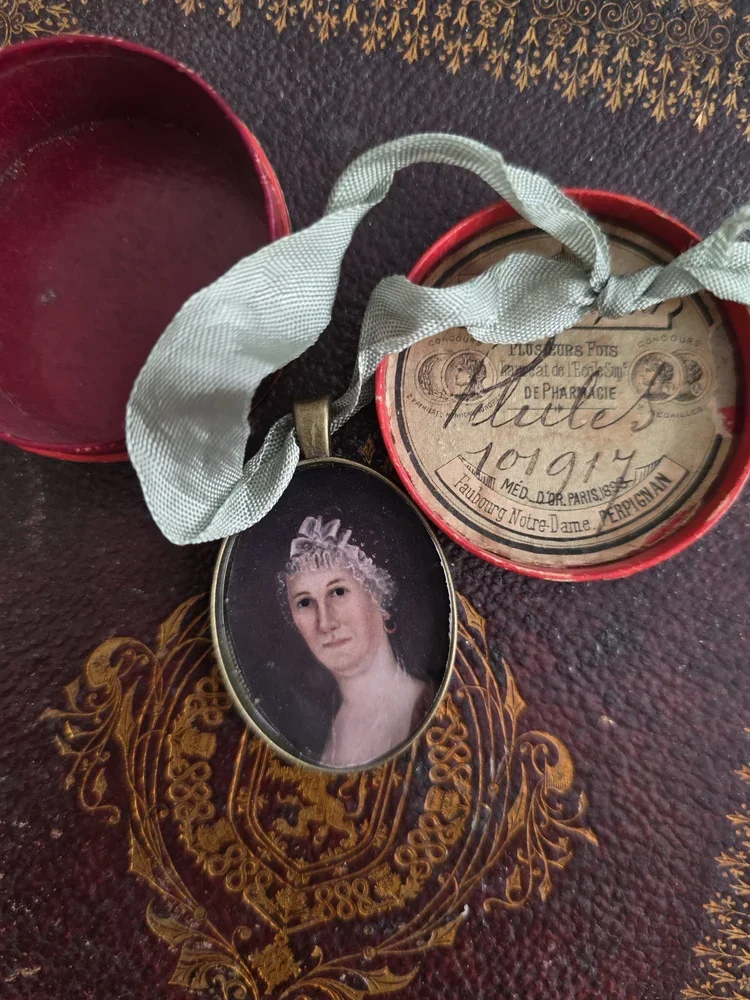
Antique and vintage finds including a hand-painted portrait miniature, faded ribbon and an old French pharmacy box dated 1917, photographed together on a dark patterned textile
If you’re immersed in the world of antiques, flea markets or vintage, you'll soon encounter a rather loose collection of terms. Antique, vintage, retro and collectible are often used interchangeably, but they don't quite mean the same thing.
So when does vintage actually become antique?
As a general rule, an antique is an object that is at least 100 years old. Vintage is less precisely defined, but is generally used for objects from a recognisable period of the more recent past, often at least 20 years old.
That sounds simple enough, but age is only part of the story. An object doesn't suddenly become rare, valuable or desirable on its hundredth birthday, and something vintage isn't necessarily less important than something antique.
Understanding the terminology can be useful when buying, collecting or simply trying to work out what you've found.
How Old Does Something Have to Be to Be Antique?
The most widely used definition of an antique is an object that is 100 years old or more.
That means the date continually moves. In 2026, an object made in 1926 or earlier has reached the 100-year mark and can generally be described as antique.
It's worth remembering that the 100-year rule is a useful convention rather than a magical dividing line. A bowl made in 1925 and one made in 1928 may have been produced in exactly the same workshop, using the same materials and methods, yet technically one has reached antique status while the other has not.
For that reason, you'll also encounter broader descriptions such as early 20th century, Edwardian or circa 1920, particularly when an exact date isn't known.
What Counts as Antique in 2026?
Here's a simple guide:
1890 · 136 years old · Antique
1900 · 126 years old · Antique
1910 · 116 years old · Antique
1920 · 106 years old · Antique
1926 · 100 years old · Antique
1930s · 86–96 years old · Vintage
1950s · 66–76 years old · Vintage
1970s · 46–56 years old · Vintage
1990s · 26–36 years old · Vintage
Of course, seeing the 1990s described as vintage may come as a small shock to those of us who remember them perfectly well.
But that's the peculiar thing about dealing with old objects. Today's ordinary possessions are quietly becoming tomorrow's vintage.
Vintage book titled Flowers, with a botanical illustration of daisies on the cover, styled with faded dried flowers.
So, What Actually Counts as Vintage?
Unlike antique, vintage doesn't have a universally agreed age threshold. The term is generally used for objects that are at least 20 years old and which belong recognisably to an earlier period.
In 2026, that means objects from the early 2000s are already beginning to fall within the vintage category, strange as that may feel.
Age alone, however, isn't quite enough. When we describe something as vintage, we're usually also placing it within the design, fashion or culture of its time. A 1950s floral fabric, a 1970s kitchen tin or a piece of 1980s stationery carries something recognisable from the period in which it was made.
This is also why the word vintage shouldn't simply be used to describe something that looks old. A newly made object inspired by an earlier period may have a vintage look, but the object itself isn't vintage.
And there is no point at which something stops being vintage because it has become too old. Once an object reaches around 100 years of age, antique simply becomes the more accurate description.
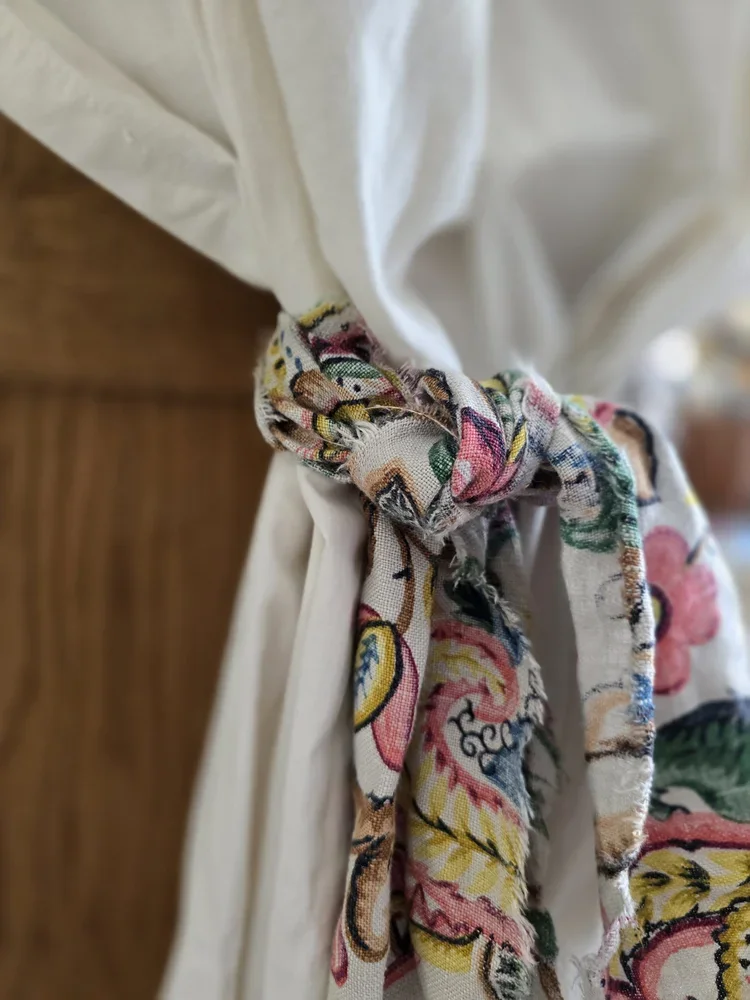
Close-up of a knotted strip of vintage floral fabric, showing faded pink, green and blue flowers and softly frayed edges.
What's the Difference Between Vintage and Retro?
Vintage and retro are often used interchangeably, but there is an important difference.
Vintage describes the age of an object. Retro describes a style.
A kitchen canister made in the 1960s is vintage because it was actually made during that period. A canister made today using 1960s colours, lettering and design might be described as retro, but it isn't vintage.
The same applies to furniture, textiles, clothing and decorative objects. Something doesn't become vintage simply because it has been designed to look old.
Of course, an object can be both. A piece genuinely made in the 1970s, with all the wonderfully recognisable colours and patterns of the decade, is both vintage and decidedly retro in style.
It's a small distinction, but a useful one, particularly when you're buying something because its age and history matter to you.
What Does Collectible Mean?
Unlike antique and vintage, collectible isn't really a description of age at all.
An object can be collectible because of its rarity, maker, design, subject matter, provenance or simply because there is a group of people who particularly want to find and own examples of it.
Some collectibles are hundreds of years old, while others are surprisingly recent. Old advertising, buttons, postcards, packaging, toys, textiles and even everyday household objects can all become highly collectible.
This is one of the things I find most interesting about buying and selling old things. An object doesn't have to have been expensive or important when it was made to become desirable later. Sometimes it is the ordinary things, used, discarded and never intended to survive, that eventually become the hardest to find.
It's also the thinking behind my Collectors Bolt collection, a place for the more unusual pieces I come across. Things that are particularly scarce, curious, beautifully made or simply a little harder to categorise.
Collectibility can influence value, but it doesn't automatically make something valuable. That brings us to another common misconception: does being antique mean something is worth more?
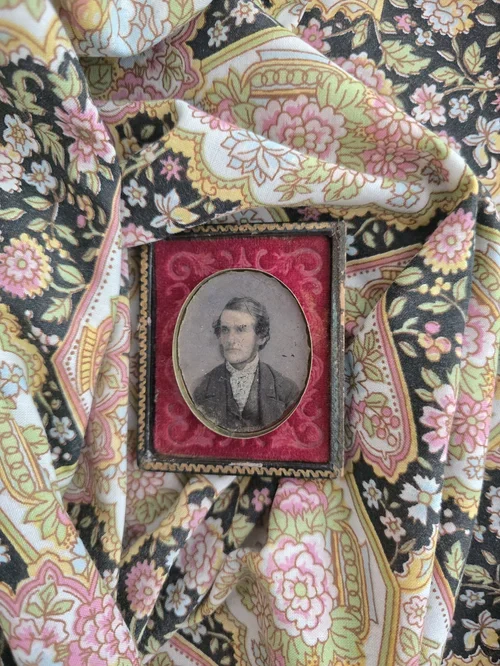
Antique portrait photograph of a young man in an ornate red velvet case, styled against richly patterned vintage floral fabric.
Does Antique Mean Valuable?
One of the biggest misconceptions about antiques is that old automatically means valuable.
It doesn't.
An ordinary object made in 1890 may be worth considerably less than a rare or highly desirable piece made in the 1950s. Reaching the 100-year mark makes something antique, but it doesn't suddenly make it valuable.
Value is usually determined by a combination of things, including:
Rarity – how many were made and, perhaps more importantly, how many have survived.
Condition – although a little wear is very different from serious damage.
Maker or manufacturer – a recognised name can make an enormous difference.
Provenance – knowing where an object came from or who owned it can add interest and, sometimes, value.
Quality and craftsmanship – materials and the way something was made matter.
Demand – collecting fashions change, and something nobody wanted twenty years ago can suddenly become sought after.
Completeness – original boxes, labels, lids, sets and accompanying paperwork can all be important.
The unusual – an uncommon colour, pattern, subject or form can make an otherwise ordinary object much more desirable.
This is why age should really be thought of as one clue rather than a valuation.
It's also one of the pleasures of looking for old things. Sometimes the most interesting find isn't the oldest thing on the table. It might be the slightly strange piece that everyone else has overlooked.
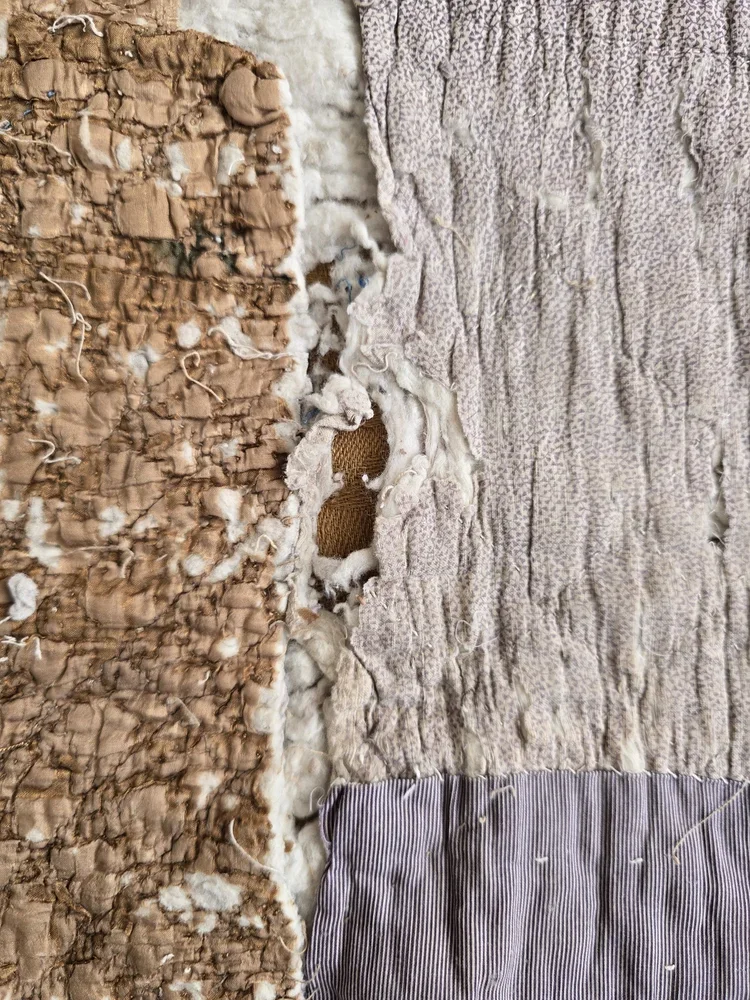
Over 100 years old, this quilt fragment is a lovely reminder that being antique doesn't automatically mean being valuable. Rarity, condition, craftsmanship and desirability all play their part.
How Can You Tell How Old Something Is?
Dating an old object isn't always as simple as finding a date stamped on the bottom. More often, it's a process of gathering clues.
When I'm trying to work out the age of something I've found, I rarely rely on just one detail. I look at how it was made, what materials were used, its labels and markings, the style of the design and the natural signs of age.
Here are some of the things worth looking for:
Materials
Materials can immediately help narrow down a period. The type of fabric, paper, wood, metal, ceramic or plastic used can all provide clues. With textiles, for example, the fibre, weave and even the width of the cloth can be useful when trying to establish age.
How It Was Made
Turn things over and look underneath. Construction can often tell you far more than the decorative front.
Hand stitching, seams, fastenings, nails, screws, joins and manufacturing techniques can all help place an object within a particular period. Old repairs can be revealing too.
Labels and Maker's Marks
Never overlook a label.
Maker's marks, manufacturer's names, addresses, country-of-origin labels, registered design numbers and old shop labels can provide some of the best clues to an object's history.
Even the wording on a label can help. Businesses changed names and addresses, manufacturing moved between countries and labelling requirements changed over time.
Typography, Packaging and Printing
Old paper and packaging can be particularly fascinating to date.
Lettering styles, printing methods, illustrations, logos and packaging design all changed with fashion and technology. Sometimes a tiny piece of printed information can narrow down a date considerably.
Style and Design
Colour, pattern and shape can point towards a particular decade or movement, whether it's an Arts and Crafts textile, an Art Deco typeface or the unmistakable colours of the 1970s.
Style alone shouldn't be used to give something an exact date, but combined with other evidence it can be extremely useful.
Signs of Age
Fading, foxing, oxidation, worn edges, patina and evidence of use can all support what the other clues are telling you.
But wear on its own is not proof of age.
New objects can be deliberately distressed to look old, while something genuinely antique that has been carefully stored may look remarkably fresh.
The best way to date an old object is therefore to look at the whole thing rather than searching for one definitive clue. Often it is several small details, all pointing in the same direction, that give you the most convincing answer.
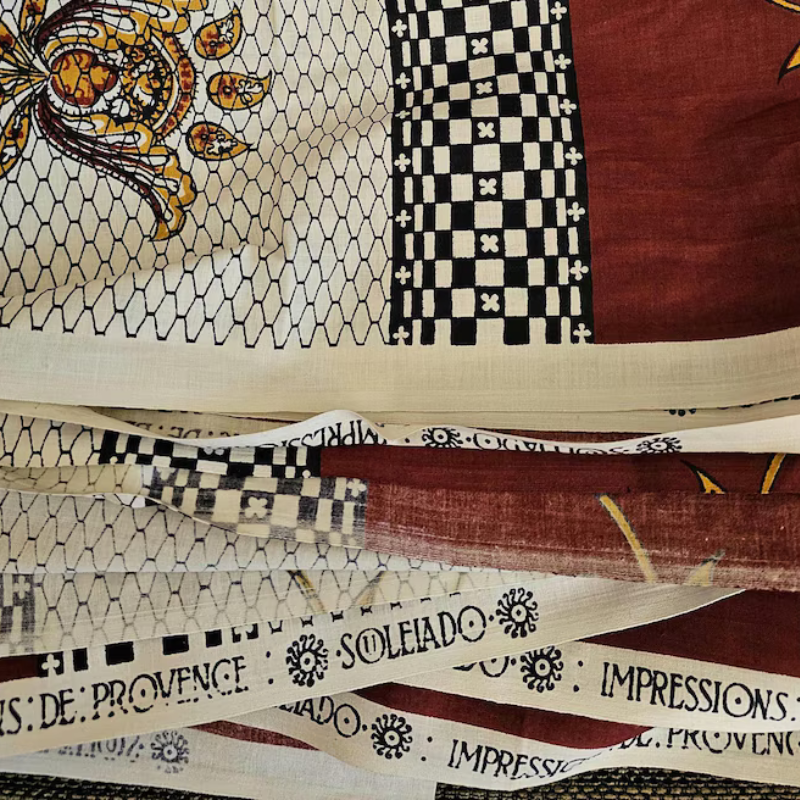
Close-up of a printed Souleiado fabric selvedge, showing the manufacturer's name and original textile markings. Selvedges, labels and maker's marks can provide valuable clues when identifying and dating vintage fabrics.
Why Dating Old Things Isn't Always Exact
Even after looking at all the clues, it's not always possible to give an old object an exact date.
Unless something is dated, documented or can be traced through a maker's records, dating is often an informed estimate. A combination of materials, construction, design and markings might tell us that something was probably made within a particular decade, but not necessarily in a particular year.
This is why you'll often see descriptions such as late Victorian, Edwardian, early 20th century, 1930s–1940s or mid-century.
You may also see the word circa, often shortened to c. It simply means "approximately" or "around". So an object described as circa 1910 is believed to date from around that time, rather than being known to have been made in 1910 exactly.
Sometimes new information changes an initial estimate too. A maker's mark, hidden label, old catalogue or even something discovered underneath a layer of fabric can suddenly provide another piece of the puzzle.
For me, that's part of the fascination of old things. You don't always get a definitive answer.
Good dating is often less about finding an exact year and more about gathering enough evidence to place an object confidently within its period. And where there is uncertainty, it's better to say so than to turn an educated estimate into a fact.
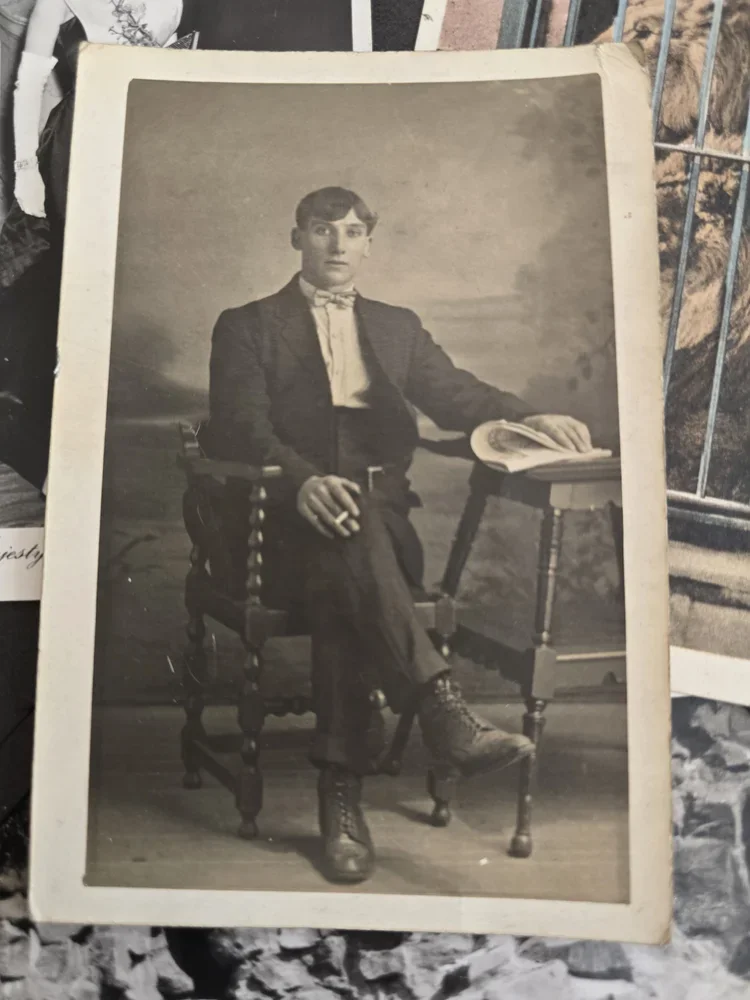
Old studio portrait of a young man, an example of how clothing, hairstyle, photographic style and presentation can provide clues to age even when an exact date is unknown.
Does Condition Matter More With Antiques?
Condition matters when buying and valuing old things, but perfect condition isn't always the goal.
An antique that has survived unused, complete and in its original packaging may be particularly valuable. But many objects were made to be used, and a hundred years of life will inevitably leave traces.
Faded fabric, worn edges, foxing to old paper, crazing to ceramics, rubbed paint, old repairs and softened surfaces can all be entirely consistent with age. For many of us, those signs of use are part of what makes an old object appealing.
There is, however, a difference between honest wear and significant damage.
A small old repair to a quilt might add to its story, while extensive deterioration that makes the fabric unstable is quite different. A little foxing on an old print may be expected, whereas severe damp or mould can affect both its condition and value.
Rarity matters too. If only a handful of examples of something are known to survive, collectors may happily accept considerably more wear or damage than they would on something readily available.
This is why condition should always be considered alongside age, rarity and desirability rather than in isolation.
Personally, I'm often drawn to objects that show their history. A beautifully faded textile or an old piece of paper softened through handling can have a character that a pristine example simply doesn't.
Sometimes the imperfections are precisely what tell us that an object has had a life before it reached us.
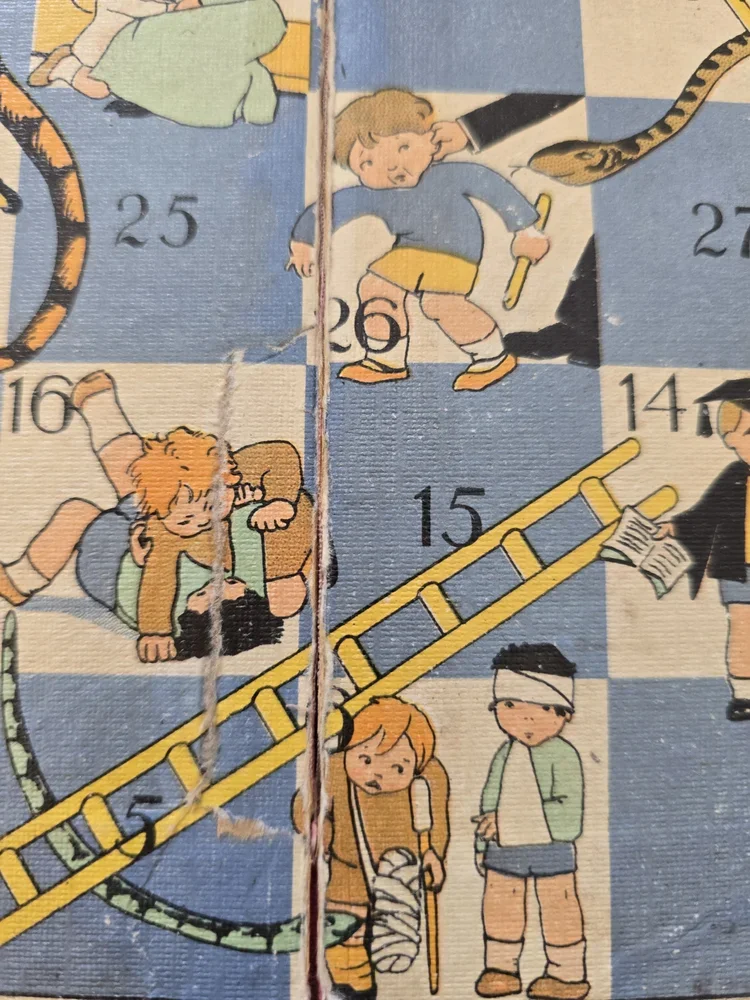
Close-up of a well-used vintage illustrated game board, showing worn edges, creases and surface damage from years of play.
Should You Clean an Antique?
Finding something old and rather grubby can make it very tempting to reach immediately for the polish, soap or stain remover. But with antiques, cleaning isn't always an improvement.
Years of oxidation, handling and use can create the surface we think of as patina, and removing it can alter both the appearance and the value of an object.
The same caution applies to textiles and paper. Washing an old fabric can cause colours to run, fibres to weaken or finishes to disappear, while attempting to remove foxing or marks from antique paper can easily cause permanent damage.
Original labels, old finishes, paint and even historic repairs can also form part of an object's story and shouldn't automatically be removed simply because they look worn.
Of course, not every speck of dust is precious. Some objects can be cleaned perfectly safely. The important thing is to understand what you're dealing with before doing anything irreversible.
If I'm unsure, my preference is always to leave an old object alone until I know more about it. You can decide to clean something later. You can't always put back what has been removed.
You can decide to clean something later. You can't always put back what has been removed.
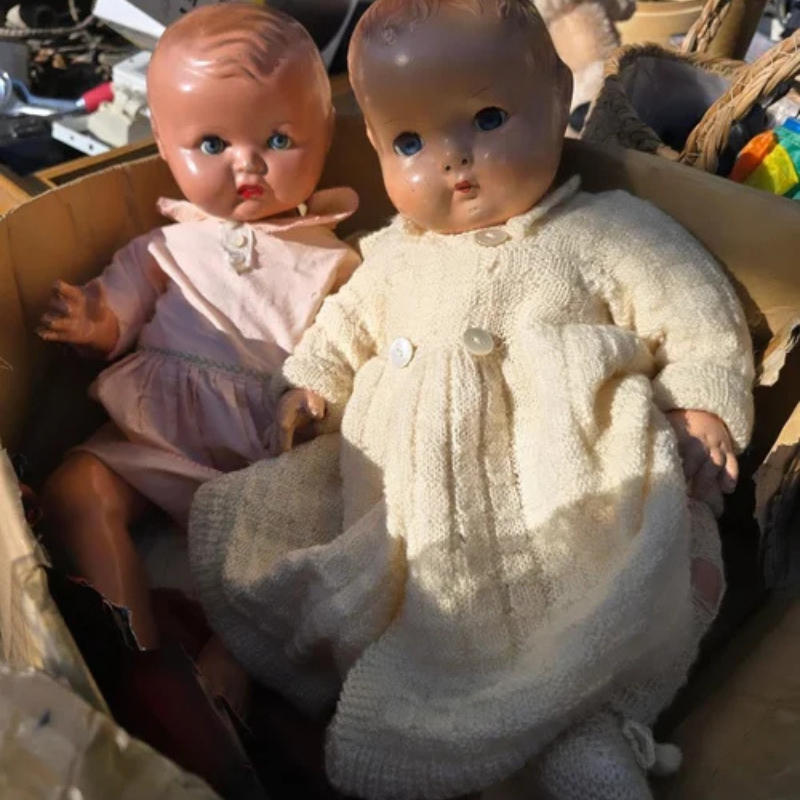
Two well-loved vintage dolls in a cardboard box, wearing softly faded pink and cream clothing and showing the gentle signs of age and use.
The Best Rule? Buy What You Love
After all the definitions, dates and rules, perhaps the most important one is simply to buy what you love.
Knowing whether something is vintage, antique, retro or collectable is useful. It helps us understand what we're looking at, whether something has been described accurately and sometimes whether the price being asked is reasonable.
But none of those things necessarily explains why we're drawn to something.
Some of my favourite finds have very little monetary value. It might be a faded scrap of fabric, an old handwritten label, a battered book or something I can't quite identify. There is simply something about it that makes me stop and look twice.
And I think that's one of the pleasures of buying old things. You don't have to collect according to rules, periods or values. You can collect because of colour, texture, usefulness, nostalgia, curiosity or simply because something speaks to you.