
A Little Belief in Fairies
The Victorian and Edwardian fascination with the fairy world
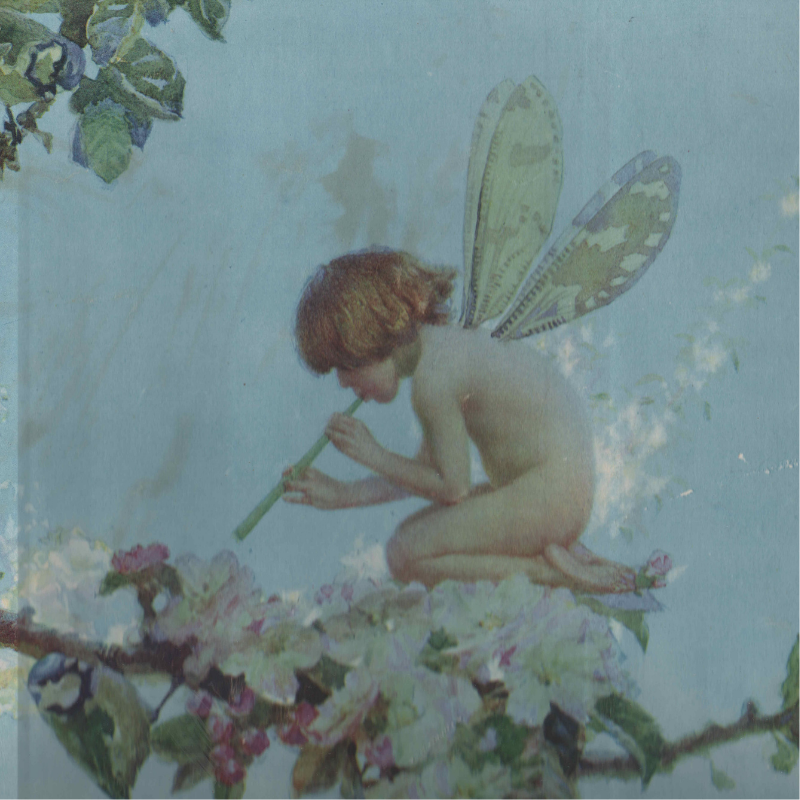
I thrifted a beautiful print. A little winged fairy sitting on a flowering branch, playing a flute, with birds gathered around her. The background is a beautiful faded blue with signs of age which adds to its allure, and the whole scene has that slightly dreamlike quality I find so difficult to resist. There's no artist's signature, no publisher's name and nothing on the back to tell me where it came from. But it got me thinking about the Victorians and Edwardians, and their extraordinary fascination with fairies.
When Fairies Were Everywhere
Fairies weren't invented by the Victorians, of course. They had been part of British folklore for centuries, and they weren't always the sweet little creatures we recognise today. Older fairy tales could be quite unsettling. I was fascinated by them and tales of their antics as a child, devouring books in the school library, learning about how they were mischievous, unpredictable and sometimes downright dangerous. They might lead travellers astray, steal children or play tricks on unsuspecting humans. But during the 19th century, something changed.
Fairies began appearing everywhere, in paintings, illustrated books, theatre productions and children's stories. They became smaller, prettier and increasingly associated with flowers, woodland creatures and childhood innocence. Victorian artists created entire imaginary worlds filled with tiny figures, elaborate costumes, moonlit landscapes and impossible gardens. And the public adored them.
An Escape from an Industrial World
I find it interesting that this fascination developed during a period of enormous change. The Victorian age was one of factories, railways, expanding cities and scientific discoveries. Life was becoming increasingly industrialised, yet artists and writers were filling their work with enchanted forests and imaginary creatures.
Perhaps the fairy world offered something that everyday life was beginning to lose. A little mystery. A connection with nature. Somewhere that couldn't be explained by machinery or science. Fairy paintings became a recognised genre, with artists such as Richard Dadd creating intricate and sometimes rather strange imaginary scenes. Not all Victorian fairies were delicate or comforting. Some were mysterious, even disturbing, which makes the artwork from this period all the more fascinating.
The Golden Age of Fairy Illustration
By the late Victorian and Edwardian periods, fairies had found a particularly happy home in children's books.
Illustrators such as Arthur Rackham and Edmund Dulac helped create the magical landscapes we still associate with classic fairy tales. There were twisted trees, tangled roots, moonlit paths and little figures hidden among the leaves. One of the things I love about these illustrations is how much there is to discover. You can look at them several times and still notice something you missed. Fairies also appeared on postcards, greetings cards, nursery pictures and decorative prints. They weren't confined to books. They became part of the decoration of everyday life.
My little print belongs to that tradition of whimsical illustration, although without knowing its artist or date, I can't say exactly when it was produced.
When People Actually Believed
Perhaps the strangest chapter in this story came in 1917, when two young cousins, Elsie Wright and Frances Griffiths, photographed what appeared to be fairies in a garden at Cottingley in Yorkshire. The photographs caused an extraordinary sensation. Even Sir Arthur Conan Doyle, the creator of Sherlock Holmes, became convinced that they offered evidence of a real fairy world. It's rather wonderful, in a peculiar way, that the man who created one of literature's most logical detectives could be so enthusiastic about fairies. The photographs were eventually revealed to have been staged using paper cut-outs. But for decades, they had captured the public imagination. And perhaps that tells us something about how much people wanted to believe.
The Fairies Never Really Left
By the 1920s, fairies were still appearing in children's illustrations, decorative prints and popular books.
Cicely Mary Barker's Flower Fairies, first published in 1923, brought another generation of tiny winged figures into the world, each one associated with a particular flower. The illustrations combined careful botanical observation with imagination, making the fairy world feel as though it might genuinely exist at the bottom of the garden. And even now, more than a century later, we're still drawn to these images. Perhaps not because we believe in fairies, but because we enjoy the possibility of something magical hiding in an ordinary place.
A Little Piece of Magic
I still don't know who created my old print. There's a little fairy playing her flute, a bird perched nearby, and branches covered in blossom. Nothing particularly grand, just a charming imaginary moment captured on paper. I rather like that it has survived, even if its story hasn't. And I think that's one of the pleasures of collecting old things. Sometimes an object leads you somewhere completely unexpected. In this case, into the curious, beautiful and occasionally rather peculiar world of Victorian and Edwardian fairies.
Perhaps we haven't changed all that much. After all, who doesn't enjoy a little magic now and again?